
If an artist were to decide that her unconscious mind and feeling states should direct her work, does she then decide that the artistic success of the piece she has created, or her whole body of work for that matter, depends on how much of her deep self is revealed or in turn how easily that work is understood by those who view it? Carl Jung the great psychoanalyst and interpreter of anthropological symbolism said, “The secret of artistic creation and the effectiveness of art is to be found in a return to the state of ‘participation mystique’, to that level of experience at which it is man who lives and not the individual.” Such is the world view of Cabbagetown artist Betty White, who successfully documents her life’s landmarks in personal, accessible and moving works of art.
Entering her work space, I am surrounded by shells, tied sticks, stones and pieces of nature, full yet organised tables of pastels, papers, books and musical instruments, cabinets of curio and treasures. I know I am walking into a specific {mind} set; the outward manifestation of the inner creativity of Betty White. A work in progress, pinned to the studio wall attracts me, other powerful works hang in frames along the hall. The large works on paper consist of sculpted pressed paper pieces; images in pastels, pencil and other media. Each handsomely framed piece in Betty’s hallway gallery, seems to represent a specific chapter of her experience; a visual Book of Hours. The sculptures; wrapped or tied pieces in small archaic looking figurative shapes, suggest a child bound to a mother, or perhaps a shaman ~ as the rock itself. Nature-crafted, artist-made talismans of some unconscious longing, or marker of change.
Born in Worcester Massachusetts in 1944, into a family of accomplished musicians and scholars and having achieved her Bachelor of Arts degree in 1966 from The University of Colorado, White began her career as apprentice to Olly Reinheimer, the prodigious Brazilian fibre artist in Rio de Janeiro. She has enhanced her skills as a textile artist, by taking paper-making workshops in Montreal and at O.C.A.D. in Toronto. She taught at The Canadian Guild of Crafts in Montreal and The School House in Toronto and ran a paper-making course for teachers at The Children’s Museum in Boston. Betty has exhibited in France, recently in Mexico; Toronto, Martha’s Vineyard and Boston and her work is in the collections of Readers Digest, The Canada Council and Art Bank. Her works are also collected privately.
Senior Art Teacher at The Montcrest School, Betty White lives her art and about that process she comments; “I plug into a sort of ‘archetypal’ imagery that makes sense; my own creative visual language. I know a piece is finished is when it’s original, natural and emotionally true.” Thus Ms. White names herself ‘Modern Primitive’…someone who somehow carries in her bloodstream, the echoes of a distant past.”
The word “Archetype” appeared in European texts as early as 1545. It is derived from the Latin noun ~ archetypum, after the Greek noun ~ arkhetypon. It means simply, “first-moulded.” Archetypes are long present in mythologies of various cultures from classical literature, such as epic myths, to modern re-workings of fairy tales. The use of archetypal symbols to understand human personalities was developed as an aspect of analytical psychology by Carl Jung in the early 20th century. The benefit of these archetypes, whether depicted in drama, or used in fiction and art, is suggested by the idea that groups and individuals are able to recognize unconsciously the themes present in character, motivation, or image. Each artist may develop an acute understanding of her/his work, say in analysis, or through their practice of making art, or even remain unaware of their own inner workings yet continue to generate a lifetime’s output, such as with some of the so called naive or primitive artists.
It is the universal experience of family life, music and an awareness of death, filtered through her specific understanding and her particular execution of materials, which attracts, then snares the viewer. “My experience with loss was the beginning of a lot of what was to come. I was well established as an artist and then lost my first child. The experience changed me profoundly. I understood how short life is and my ’emergency’ magnified and intensified my experience of life. I loved every exquisite moment of being alive. It also accelerated and intensified my experience of art-making and I processed this through my artwork for many years. Initially my work was motivated by childhood memories and poetry, which I adore. Be it a poem, a novel or a good opera, they all contain the element that cuts across and touches you deeply.”
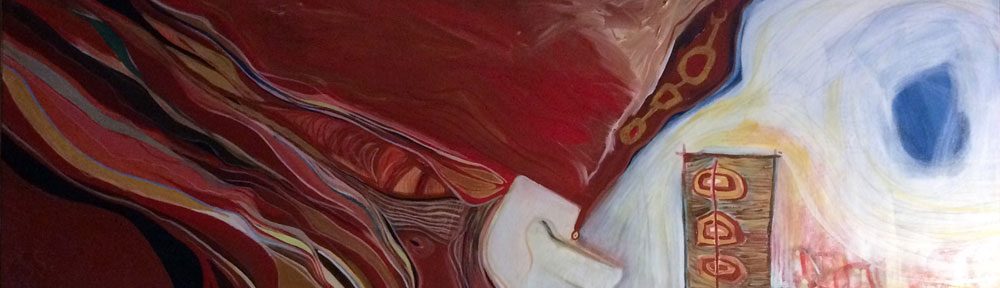
Her love of music and musical influence is evident in the exploration of a poem regarding The Viola D’amore; by Irish poet Moya Canon. Betty’s connection to dream states and her womanly expression of powerful and resonant ideas, is depicted in “The Mother, The Child” seen here, where the cello body becomes that of the mother. Woman as vessel.
Ms. White’s work has been in demand over the many years of her career. “In the early days, I was a free spirit, I’ve grown in growing and growing up. I see the world reflected in the children I teach and I’ve scratched my way into that awareness, that as an artist, you live out the tensions of the culture you’re living in. You know, I don’t let my works go unless they’re going to a place they’ll be cherished.” White says “The language of my work is love, dreams, music, children and family and in that, we’re all connected.”
