Are we living in the Anthropocene? This Ontario lake could help global geologists decide
Reply
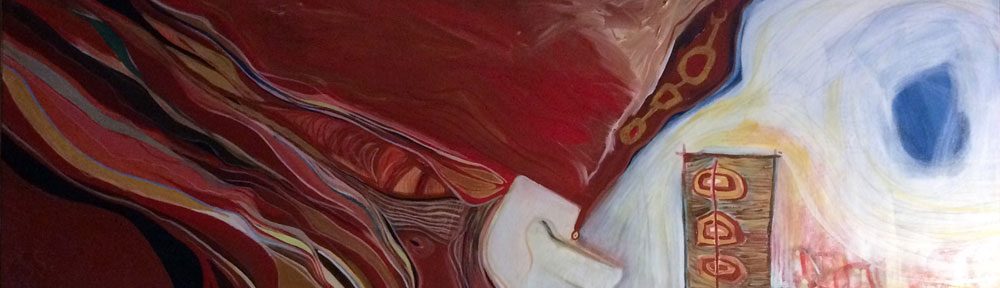

I first met “Canada’s Premiere Outsider Artist” Menno Krant in 1995 when he, I and several other self-titled “Outsiders” exhibited at Tableau Vivant Gallery on Queen West. We had formed a casual collective and placed ourselves apart from the mainstream gallery-elite in Toronto. Not hard, considering the group was composed of ‘folk’ or naïve and underground artists whose work spoke directly to social justice issues, some participants even questioning their identities as artists. Generating an electronic-based piece, distanced me from the Outsider realm of art making.
Legend has it that Menno at that time was living in his car and resting his canvasses on the trunk to paint; dipping his pieces in the lake and letting them dry on his car roof. Menno says it didn’t occur to him that he was even painting. He was primarily “passing time” and not in contact with any one in the art world. Through his association with folk art/antique dealer, Phillip Ross in Toronto his raw, gorgeous work was discovered by a New York Dealer and he became an art sensation.
Menno, rather reclusive, “invisible, a ghost” in his own words, is currently enjoying a new kind of celebrity. His works are being studied and written about in the form of a Doctoral Thesis by Mr. Peter A.L. McCormack, of London England, who suggests that Menno can no longer be classified as a ‘traditional’ Outsider Artist.
What makes “Outsider Art” truly ‘outside’? French wine merchant and occasional painter Jean Dubuffet, a champion of “L’Art Brut”, coined this term in 1948 to describe the art of the untrained, marginal or mentally disturbed. The term is often a “catch-all” phrase, miss-applied regardless of content and context, although Outsider Art definitions are changing and expanding. Cabbagetown’s rather anonymous shopping-cart installation artist is a fine example, leaving his beautiful, fugacious offerings tied to lampposts.
Outsider Artists, such as famed Scottie Wilson, a one time Toronto resident, or Aloise Corbaz, tend to make art obsessively and may generate thousands of pieces in their creative lives. Many suffer what is called “Horror Vacui” a tremendous fear of leaving empty space on the canvas. Typical of outsider art is a completely art-covered surface. Only since the 1920’s has L’Art Brut been given the merit it deserves as genuine avant-garde expression.
Although Menno’s repetitive imagery and high productivity are typical of outsider painters, Mr. McCormack, an art historian, places Menno as a kind of Modern Outsider. This means Menno’s work, because of its anthropological nature could be placed within the boundaries of Modern Art, in a sense, putting Outsider Art inside Modern Art.
Menno Blue; Menno’s latest exhibit, “ …explores themes of isolation, identity and attachment…” says curator Jodie James Elliot. The works; some 50 canvasses, were generated from the artist’s involvement with online Smurf collectors and “…examine issues of legitimacy and authenticity, gender politics, anxiety, mistrust and the collapse of empires…” Menno’s transition from outsider to authority within this virtual community provides intriguing information regarding this new body of work, which may be considered rather subversive, even in the Modern Art community.
“We are all brothers and sisters,” says Deva Gunaseelan, principal dancer and choreographer of The Gunaseelan Dance Company, “despite our differences, dancing expresses the divine in us, it transforms, inspires and educates us.”
Scholar, yoga instructor, theatre advisor, costume/prop-maker and painter, among numerous other advanced talents and skills, Deva presents his expansive, energetic dance works regularly in many venues, internationally and here in Toronto. Based in Cabbagetown with wife and company administrator, Kavitha and young daughter Rajitha, Deva Gunaseelan is the creator of The Flow Technique, a modern approach incorporating Yoga principles and practices, kinesthetics and contemporary themes, to the rigorous Bharatanatyam form of classical Indian dance, which enables dancers of all ages, sizes and levels to experience the joys of dancing, without injury to the body.
Originally from Chennai, South India, Deva began his studies in classical dance at age five. His first teacher was his Mother, Mrs. M. Gnanambighal, dancer, soloist, choreographer and professional vocalist of Carnatic, or South Indian music. Her father was the famous Guru Konnor Mahakavi V.V. Murugesa Bhagathavar and the coordinator of CSI Educational Schools, India, and her teacher. Deva is a seasoned performer of some twenty years.
A Theosophist, Gunaseelan studied the revised dance modality as taught by Rukmini Devi Arundale, a Brahmin woman, who in the 1930’s modified this ancient dance form by removing some stylistic and thematic components, notably the “Sringar” or Tantric aspects considered objectionable in some circles of the day. After the departure of the British from India in 1948, classical Indian dance was reinvested with many religious aspects specific to Hinduism.
Arundale founded the Kalakshetra School of Dance, in Chennai, South India, which taught all aspects of Bharatanatyam; balance, grace, intelligence, hard work, steadiness, special instruction in expressions of the face, clarity of speech, singing and more. She was greatly influenced by Anna Pavlova, the Great Russian ballerina and The Theosophical Society of India, which espoused a Universal Brotherhood of Humanity, without distinction of caste, sex, race, creed, or colour. Today, Bharatanatyam and other Indian dance forms, such as Kathakali, are performed all over India and internationally, by people of all religions, races and genders.
The central expression of arts in India is contained in the concept of Bhakti, or devotion. The Carnatic music that accompanies it is inseparable from the dance form. In Bhakti, Bharatanatyam, “Bha” (Bhava or expression), “Ra” (Raga or melody) and “Ta” (Tala or rhythm), celebrate the divine, manifest in the body. It consists of graceful and elaborate gestures or Mridu Angaharas, sentiments called Rasas, emotional states referred to as Bhavas and actions or Kriya. Deva works with each individual dancer incorporating classical and modern aspects of dance, as he assists them in bringing to bear their unique expression of all the elements of Bharatanatyam, Kathakali and dramatic story telling.
Gunaseelan uses diverse, universal themes, folklore and modern concepts in the development of his choreography. He and his company have danced for peace and dedicated an evening’s programme to the 9/11 tragedy. He has also performed Tamil “Street Dances” or Theru Koothu and many other South Indian dance styles. Gunaseelan has a fine reputation for his unique approach to dance, his very active and extensive community involvement and his generous and compassionate teaching technique.
“We have both dancers and students of all ages and professions and we encourage people of different levels of fitness to come to classes as well,” Deva states enthusiastically. Gunaseelan wants his students to enjoy themselves, especially young ones. He and Kavitha both feel the universal aspects of dance are necessary for young people to experience. “They need to be given positive encouragement to express themselves,” said Kavitha, “to set them in the right direction.” Kavitha, smiling, admits that although Deva may be a man of few words, he expresses much of himself through dance. “It’s hard sometimes to talk about personal things with him, he dances instead of talking!”
To sign up for classes or for more information, call 416.944.2392 or
emailgunadance@yahoo.com.

Georgian culture is ancient, dating back to at least the 7th century BCE. “Sakartvelo,” the Georgian word for Georgia, is a small country located on The Black Sea, containing many provinces with diverse picturesque landscapes. From the magnificent snow-tipped Caucasian Mountains to its lush fields and valleys, Georgia contains subtropical deserts, as well as alpine zones. A gateway between the Christian West and the Muslim East, Her peoples are known for their hospitality and loyalty. Georgians are also renowned for their bountiful vineyards and are celebrated for their wonderfully diverse, polyphonic music.
“Many musicologists talk about Georgian polyphony developing as early as 400 CE,” says Reid Robins, who is the group’s baritone voice. “Polyphony is a musical texture consisting of two or more independent melodic parts. Georgian folk music is one of the oldest traditions of polyphonic music in the world.”
In 2002 Robins joined forces with Andrea Kuzmich and Shalva Mahakashvili in forming a new vocal trio which they named Zari (meaning “bell and “lament”). The trio has seen five exciting years, with three trips to Georgia, many concerts in Toronto, a CD and well-received performances at the St.John’s Sound Symposium.
The three virtuosos bring substantial experience to the group and each offers a unique gift with which Zari achieves its beautiful blended sound. Currently Zari is considered by many to be one of the finest Georgian vocal trios in the world.
Shalva, the group’s native Georgian is “the real thing,” comments Robins. “He has been a musician since childhood and grew up busking on the streets of downtown Rustavi. He not only knows the folk music but is a wonderful instrumentalist as well. He has that unmistakable Georgian sound which brings authenticity to the group. He is in my opinion, the spiritual centre of Zari.”
Shalva’s partner in Zari and in life is Andrea Kuzmich, an accomplished jazz singer and Ph.D. student in musicology. “Andrea brings an unusual component to Zari in that she is singing music that has typically been sung by men,” notes Robins. “Academics, other musicians and the music loving public have responded with acceptance and surprise, because she does what she does so well. All three of us are devoted to learning this incredible material and have found a
balance between a growing facility with the music and humility in seeing how much there is to learn. This comes from having heard the very best. ”
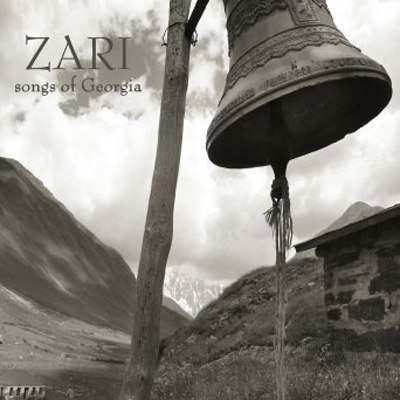
Their first CD, “ZARI: Songs of Georgia” includes earthy renderings of work songs, beautiful love songs, lullabies and moving liturgical pieces. Zari’s repertoire is extensive and they have performed in Georgia in front of esteemed guests such as Georgian President Mikheil Saakashvili, The Patriarch of the Orthodox Georgian Church and well-known master musician Anzor Erkomaishvili.
With the current political scene and North American influences making their way into Sakartvelo, Robins is moved by the continued reverence Georgians have for performing and interpreting their ethnic folk musics. “Georgian music is still one of the world’s great secrets.” says Robins. Zari offers it to us beautifully, to delight our hearts and spirits.
 ‘Cabbagetown Photographer’ Eric Morse opens new exhibit May 1, 2012
Gregarious and oft’ seen ~ camera ’round neck, beret on head, rushing to and fro, or heading up Parliament Street at breakneck speed, Eric Morse has a very wide photographic territory and quite the ‘singular eye’ for detail.
Dubbed “The Cabbagetown Photographer” by former Cabbagetown BIA Chair Paul Dineen, Eric covers all of the Cabbagetown Festivals, functions at local charities, “dos” for politicians, and events at the Military Institute. He has taken an unanticipated sabbatical from artistic photography since March 2009 due to involvement in the provincial elections administration, but returns with an exhibition at the Parliament St Library (Parliament and Gerrard Streets), opening May 1 and running to May 31.
As a young boy ‘somewhere near Chapleau, Ontario’, Eric was given a Brownie Hawkeye plastic camera and went about “pestering” everyone for pictures. Morse says he has “some very blurry, very crooked, square photographs of his Grandmother’s knees! “You know, I had a relatively normal northern Ontario childhood, I grew up in small towns and lumber settlements in the Canadian shield, and…” he laughs, ”because nature was all around me, the object of my photography when I first got my hands on a camera, was to escape it, as much as possible!”
Later on, Eric did his degree in Soviet and Eastern European Studies at Carleton, “…which was all the rage at that point as International Relations and Defence Studies seem to be today. After my degree, I went off and spent a year at Leningrad State University, when it was exotic but not so fashionable. When I returned, there were only three things I could be: a ‘spook’ (spy), a diplomat, or a journalist and so I became first one, and then another of those.’
Morse has worked extensively in the non-profit and government relations sectors and has had a lengthy relationship with Canadian business, amateur sport, cultural and political communities. He is currently the Director of Communications for the RCMI. He also writes on international and foreign relations themes, appearing regularly in the Ottawa Citizen and occasionally in the Toronto Globe and Mail and the Star. He also reports and shoots for The Bulletin.
Throughout his life, Eric says photography has become important to him, progressing gradually to serious art. Streetscapes and streetcars have been two of his pet subjects. “Streetcars are very large, amiable, bright forms of urban wildlife” he quips, “they’re interesting and stimulating subjects, And of course right now they are in the centre of this current remarkable breakdown in civic politics.”
Former Mayor David Miller owns four miniatures of his streetcars, which under a previous administration hung proudly in City Hall.
Morse’s photographic style is realistic, journalistic, keeping the photographic essence of the image while introducing graphic elements into the background. Colour tends to be sparse and restricted to essential elements. “I’m unabashedly retro,’ he says. ‘As digital image-making has matured technologically and become pretty much everyone’s idiom – way more so than the Kodacolor print ever imagined being – there seems to be a stylistic reaching back…often not so much a replication of styles as of feeling.”
Eric’s lovely and well-known images of Cabbagetown, Riverdale Farm, The Island and his streetcar shots have been exhibited in many venues such as, Ben Wick’s; The Left Door, Praxis Gallery and City Hall among others. The twenty works featured at the May exhibition will feature a combination of old favourites and a selection of new works. The exhibit opens May 1 at 6 pm.
For selections of Eric’s images, visit http://www.photoshop.com/users/emorse.