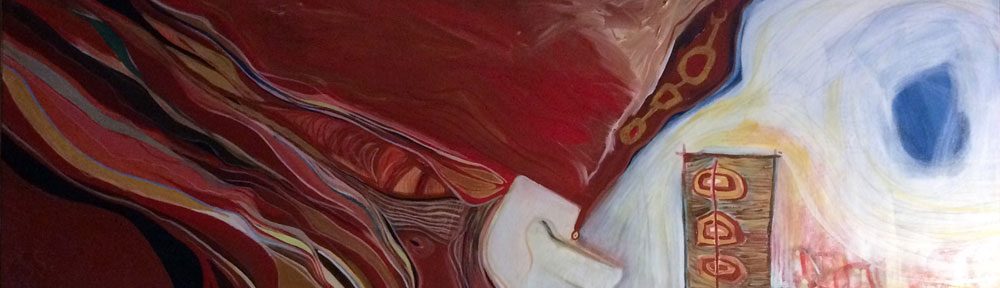
Betty White: Art Sanctifies Experience


If an artist were to decide that her unconscious mind and feeling states should direct her work, does she then decide that the artistic success of the piece she has created, or her whole body of work for that matter, depends on how much of her deep self is revealed or in turn how easily that work is understood by those who view it? Carl Jung the great psychoanalyst and interpreter of anthropological symbolism said, “The secret of artistic creation and the effectiveness of art is to be found in a return to the state of ‘participation mystique’,  to that level of experience at which it is man who lives and not the individual.” Such is the world view of Cabbagetown artist Betty White, who successfully documents her life’s landmarks in personal, accessible and moving works of art.

Entering her work space, I am surrounded by shells, tied sticks, stones and pieces of nature, full yet organised tables of pastels, papers, books and musical instruments, cabinets of curio and treasures. I know I am walking into a specific {mind} set; the outward manifestation of the inner creativity of Betty White. A work in progress, pinned to the studio wall attracts me, other powerful works hang in frames along the hall. The large works on paper consist of sculpted pressed paper pieces; images in pastels, pencil and other media. Each handsomely framed piece in Betty’s hallway gallery, seems to represent a specific chapter of her experience; a  visual Book of Hours. The sculptures; wrapped or tied pieces in small archaic looking figurative shapes, suggest a child bound to a mother, or perhaps a shaman ~ as the rock itself. Nature-crafted, artist-made talismans of some unconscious longing, or marker of change.

Born in Worcester Massachusetts in 1944, into a family of accomplished musicians and scholars and having achieved her Bachelor of Arts degree in 1966 from The University of Colorado, White began her career as apprentice to Olly Reinheimer, the prodigious Brazilian fibre artist in Rio de Janeiro. She has enhanced her skills as a textile artist, by taking paper-making workshops in Montreal and at O.C.A.D. in Toronto. She taught at The Canadian Guild of Crafts in Montreal and The School House in Toronto and ran a paper-making course for teachers at The Children’s Museum in Boston. Betty has exhibited in France, recently in Mexico; Toronto, Martha’s Vineyard and Boston and her work is in the collections of  Readers Digest, The Canada Council and Art Bank. Her works are also collected privately.

Senior Art Teacher at The Montcrest School, Betty White lives her art and about that process she comments; “I plug into a sort of ‘archetypal’ imagery that makes sense; my own creative visual language. I know a piece is finished is when it’s original, natural and emotionally true.” Thus Ms. White names  herself  ‘Modern Primitive’…someone who somehow carries in her bloodstream, the echoes of a distant past.”

The word “Archetype” appeared in European texts as early as 1545.  It is derived from the Latin noun ~ archetypum,  after the Greek noun ~ arkhetypon. It means simply, “first-moulded.” Archetypes are long present in mythologies of various cultures from classical literature, such as epic myths, to modern re-workings of fairy tales. The use of archetypal symbols to understand human personalities was developed as an aspect of analytical psychology by Carl Jung in the early 20th century. The benefit of these archetypes, whether depicted in drama, or used in fiction and art, is suggested by the idea that groups and individuals are able to recognize unconsciously the themes present in character, motivation, or image. Each artist may develop an acute understanding of her/his work, say in analysis, or through their practice of making art, or even remain unaware of their own inner workings yet continue to generate a lifetime’s output, such as with some of the so called naive or primitive artists.

It is the universal experience of family life, music and an awareness of death, filtered through her specific understanding and her particular execution of materials, which attracts, then snares the viewer. “My experience with loss was the beginning of a lot of what was to come. I was well established as an artist and then lost my first child. The experience changed me profoundly. I understood how short life is and my ’emergency’ magnified and intensified my experience of life. I loved every exquisite moment of being alive. It also accelerated and intensified my experience of art-making and I processed this through my artwork for many years. Initially my work was motivated by childhood memories and poetry, which I adore. Be it a poem, a novel or a good opera, they all contain the element that cuts across and touches you deeply.”

Her love of music and musical influence is evident in the exploration of  a poem regarding The Viola D’amore; by Irish poet Moya Canon. Betty’s connection to dream states and her womanly expression of powerful and resonant ideas, is depicted in  “The Mother, The Child” seen here, where the cello body becomes that of the mother. Woman as vessel.

Ms. White’s work has been in demand over the many years of her career. “In the early days, I was a free spirit, I’ve grown in growing and growing up. I see the world reflected in the children I teach and I’ve scratched my way into that awareness, that as an artist, you live out the tensions of the culture you’re living in. You know, I don’t let my works go unless they’re going to a place they’ll be cherished.” White says “The language of my work is love, dreams, music, children and family and in that, we’re all connected.”


Clive Holden; This Artist’s Destination ~ Utopia


Widely exhibited an internationally lauded for his film poem series, Trains of Winnipeg; writer and moving image artist Clive Holden lives in Riverdale with wife and Giller Prize nominee, Alissa York. Currently Holden is in production on his comprehensive new project Utopia Suite, segments of which were launched at Images Festival in Toronto, in April 2006 followed by the European launch in Amsterdam at The Holland Festival. Utopia Suite is a visually and contextually complex, meticulously rendered, multimedia investigation of current views regarding the concept of  Utopia.

Inspired to begin his new project while conversing with friends at a film Festival in Europe, Holden explains, “Utopia Suite is about maintaining hope. Being conscious about what’s going on in the world without losing hope is extremely difficult. I feel that hope is a very important ingredient of remaining politically progressive. And I  think movement is required to make hope… which interests me because I make art with moving images, and I think that this movement itself is Utopia, it’s the destination.”

Utopia is currently understood as meaning an ideal or hypothetical society. It has been used to describe both intentional communities and some fictional societies as portrayed in literature, however the term has been used pejoratively, often by rightist media says Holden; referring to an unlikely place or unrealistic ideal. Holden believes it became out of fashion to discuss idealistic issues as recently as the early seventies. “It’s funny to think that hope would be considered outdated and this may be changing now. I’m tracking the use of the word  Utopia on news sites on the web and it’s cropping up much more than say, three years ago. Recently the word started appearing in the centre left and more progressive media but very cautiously. Op Ed pieces would contain questions like ‘Is it time to start thinking like this again?’ They wanted to not make the same mistakes that it’s perceived we made in the sixties, or I think simply to not be laughed at.”

Holden made some initial discoveries regarding this topic, early on. “As a teenager I discovered both Utopian and Dystopian literature.” He comments. “I read Orwell, Huxley and then Sir Thomas More’s  Utopia. Now, I’m trying to approach Utopianism as a dynamic and organic process, rather than as a static edifice or place. What is the ideal state, or city, or world? These ideas can be very problematic in the way they’ve been presented traditionally, often with built-in racism or a slave class for example.”

With such a seemingly boundless concept, Holden’s creative process is indeed lengthy, each project potentially taking many years to complete. “I spent the first year reading and researching but I’ve now moved into the core of what I do, or the production phase of making films, videos and the actual moving images. 2008 will be the first year when I’m really going to roll out the work and show it in galleries and at film festivals. One of the things I’m looking at, is a blend of ways to exhibit the work… I also work with text, music and web culture, so the different elements of the ‘suite’ are really conversations between various subcultures in the art world, which is utopian in a way.”

The project incorporates Holden’s strikingly beautiful looped, split screen montage and full screen images with sound and text, in a cycle of films with such titles as Utopia Suite Disco, You Are Being Remembered, Engines of Despair and Jesus Jesus Jesus, dealing with a substantial array of segmented concepts revolving around the central Utopian theme.

In his work, Holden continually disrupts the narrative in an experimental fashion. He admits “It’s very difficult for an artist to subvert or sidestep narrative, because people think by making patterns and they have a love for this, it’s pleasurable––narratives are just patterns, so they’ll build them out of the raw materials you give them. Many film-goers have very conventional ideas of how to view a movie.” Holden believes that we are now unlearning some of the many film conventions we’ve taken for granted. “Ideally, I’d prefer that people approach my films in the way they might listen to music, where they often have a wider range of tastes and more tolerance for complexity.”

Utopia Suite will take Clive Holden into 2012 or 2013. As the project comes to its end, it will include a final large-scale installation; there will be a book, the texts and all the work will be reflected on the web as the project progresses and expands. You can visit/audit Clive Holden’s expansive Utopia Suite in progress, with supporting materials at: http://www.utopiasuite.com/

Skulu Mari; Emerging Roma Artist depicts reality of Roma Life.

The history of the Roma Peoples is difficult and painful to recount. For centuries they have suffered severe persecution, particularly in Europe. Even before the Christian Witch Craze during the late Middle Ages and Renaissance, the Roma were brutalized; during the Holocaust and before, the Roma peoples were the victims of attempted genocide.

Sadly, racist hatred and attacks directed at the Roma within Eastern Europe have intensified of late. They are significantly discriminated against in terms of employment, social services including access to basic education and do not receive adequate health care.

The Roma are prime targets of Neo-Nazis and Skinheads and Roma women have their own particular issues to deal with, such as forced involuntary sterilisation. Governments in the E.U. have done little to guarantee them fundamental human rights, although on May 1, 2004, when ten countries, joined the European Union, some four million Roma became citizens of the EU, with the right to live and work throughout.


Ms. Hutchinson, the Artistic Director of Loki Gili (Song of sorrow, Song of Hope), a pan- Roma event featuring Roma culture and an artist and activist of note, asked the women in the group to paint Roma life ‘before and now’. “I forgot I didn’t know how to draw and right away, I stared to draw everything!” Mari exclaimed enthusiastically.

She began with subjects dear to her, paintings of home and her very musical family. In one piece she portrays hopeful young lovers in a poppy field. Poppies are a seminal symbol of the Roma, “if the poppies die, the Roma die!” Mari emphatically stated. The famous Caravans depicted in the painting shown here are symbolic of “…the Roma peoples, searching always the world, for a home…” She has also painted, a menacing skinhead verbally bashing a Romani woman. Mari’s painting has blossomed in the last eight months.

“I’m sure that God wanted Lynn to start the artist’s project at CultureLink.” Mari said, “I have to thank her because she got me started painting.” Lynn remarked of Mari, “Maria is an intuitive artist. She has an innate sense of colour, composition and design, which emerge spontaneously in her rapid-fire paintings. They are passionate outpourings from the soul. I believe she is a visionary. Watching her paint, I was struck by the intensity, immediacy and physicality she brought to the process.”

Skulu Mari has been an activist in other ways regarding drawing attention to the Tsigani plight. She has written upward of thirty letter-petitions to various International bodies such as The European Court of Human Rights in Strasbourg, Pope John Paul II, The Hague, and others. Her political motivation, only to have all Roma recognized as persecuted peoples in need of international protection.

Rather than her expression healing her early wounds, Skulu Mari says sadly, “When I painting, I crying inside, I remembering (the) “You Gypsy; You Gypsy!” slurs of childhood, referring to the pejorative term used to debase the Roma, mistakenly identifying the place of their origins as Egypt rather than the State of Rajasthan, in North West India.

“Roma people like dogs in this world, always flying in packs and always screaming.” Skulu Mari wants people to recognize that Roma peoples are human beings, just like everyone else. She insists she has no personal motivation to paint. “I don’t want be famous, I paint for my people.”
————————–
I would like to Thank Julia Csanyi and Sue Fazekas for translating Mari so wonderfully and Lynn Hutchinson for her guidance. First Published in The Voice of Cabbagetown in 2009. © tammaro